
Develop the creativity, innovation and leadership capabilities required to adapt to change, stay competitive, improve your and your team’s performance and make a positive difference in the world.
Arts-based learning is an interdisciplinary approach to learning, using the creative processes of the successful artist as a pathway to nurture skills such as leadership, team management, and collaborative productivity.
Creativity: The misconceptions
Let’s begin by stating some of the most common misconceptions about creativity:
- Creativity is something which only a very select group of people have – It’s that unique talent and gift that set them apart and above from everyone else
- One is either born creative or not
- Creativity is about artistic expression
- Creativity is divinely inspired and unpredictable
The Truth About Creativity
Creativity is a systematic process and essential engine of the innovation wheel. It can be learned by understanding and applying the creative thinking process.
George Land’s Creativity Test
In 1968, George Land and Beth Jarman conducted a research study to test the creativity of 1,600 children ranging in ages from three-to-five years old, using the same creativity test they devised for NASA to successfully measure “divergent thinking.” The assessment worked so well they decided to try it on children. He re-tested the same children at 10 years of age, and again at 15 years of age. And when adults 25 years and up were tested the results were astounding.
5 year olds: 98% of children scored at a genius level of imagination
10 year olds: 30% of the same children were highly creative
15 year olds: 12% of the same children were highly creative
Same test given to 280,000 adults: only 2% were highly creative
Watch George Land discuss his creativity study at the 6:08 mark during his Tedx talk:
“What we have concluded,” wrote Land, “is that non-creative behavior is learned.”
(Source: George Land and Beth Jarman, Breaking Point and Beyond. San Francisco: HarperBusiness, 1993)
George Land, Ph.D. (1932 – 2016) was an author, a general systems scientist and Fellow of the World Business Academy.
Why aren’t adults as creative as children?
For most, creativity has been buried by rules and regulations. Our educational system was designed during the Industrial Revolution over 200 years ago, to train us to be good workers and follow instructions.
Can Creativity be Taught?
Creativity is not learned, but rather unlearned. Yes, creative thinking processes can be learned. Here is an abstract from a study on The Effectiveness of Creativity Training:
Over the course of the last half century, numerous training programs intended to develop creativity capacities have been proposed. In this study, a quantitative meta-analysis of program evaluation efforts was conducted.
Based on 70 prior studies, it was found that well-designed creativity training programs typically induce gains in performance with these effects generalizing across criteria, settings, and target populations. Moreover, these effects held when internal validity considerations were taken into account.
An examination of the factors contributing to the relative effectiveness of these training programs indicated that more successful programs were likely to focus on the development of cognitive skills and the heuristics involved in skill application, using realistic exercises appropriate to the domain at hand.
The implications of these observations for the development of creativity through educational and training interventions are discussed along with directions for future research.
(Source: Ginamarie Scott, Lyle E. Leritz, and Michael D. Mumford, Creativity Research Journal, 2004, Vol. 16, No. 4, 361–388)
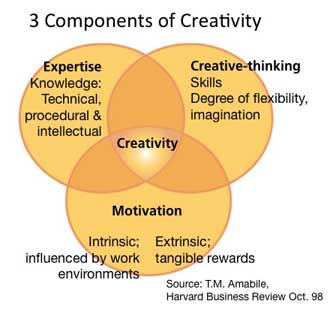
Creativity is a skill that can be developed and a process that can be managed. Creativity is built upon a foundation of knowledge, learning and practicing a discipline, and then mastering ways of thinking that can turn your ideas into reality. We can learn to be creative again by experimenting, exploring, questioning assumptions, using imagination and synthesizing information.
- Connect and synthesize new experiences
- Break old patterns
- Reinterpret needs that reflect the current situation
- Look to nature
- Force illogical assumption combinations
- Build on the ideas of others
- Welcome creative tension
- Prioritize play
- Encourage boundary crossing (e.g. divergent thinking)
Some Words to Live By
We can be whatever we have the courage to see.
Alexandria Ocasio-Cortez
Patience is not the ability to wait but how you act while you’re waiting.
Joyce Meyer
The more you practice, the luckier you get.
Anonymous
 Lundius Creative Consulting